
Education centre
How security window film works
A clear, plain-language explanation so you can make an informed decision about your home.
If you have ever wondered whether a thin film can really make a window more secure, you are asking exactly the right question. The short answer: yes, within realistic limits. Here is how it works, in plain terms.
Ordinary glass fails the same way every time. One sharp impact and it shatters into pieces, leaving an open hole. That is what makes a glass entry point attractive, since it is fast and quiet to defeat. Security film changes that equation.
A tough, bonded layer
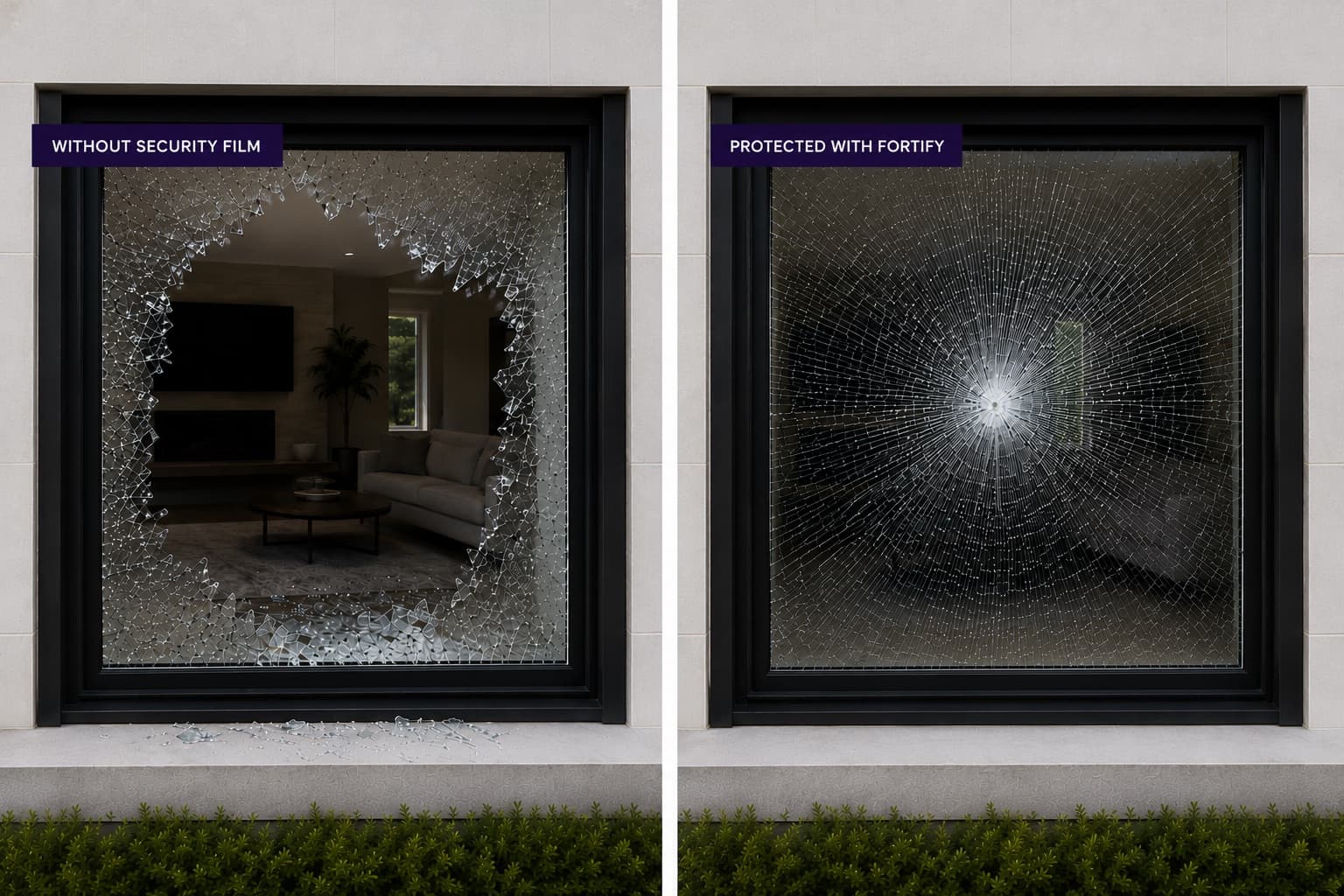
Security film is a thick, optically clear polyester laminate bonded to your existing glass. When the glass is struck, the film holds the broken pieces together instead of letting them fall away, so there is no quick, clean hole to reach through.
The frame attachment matters
Film on the glass is only half the system. If the filmed pane can be pushed out of its frame, the benefit drops. Where appropriate, we use attachment methods that keep the filmed glass connected to the frame under force.
It buys time and makes noise
Most opportunistic break-ins rely on speed and silence. Glass that will not cleanly shatter forces repeated, loud, time-consuming effort, exactly what an intruder wants to avoid. That delay is the protective value.
You would never know it is there
Clear security film looks like ordinary glass once installed. You keep your view and natural light, with a protective layer working quietly in the background.
Film vs. window tint
Why this is not the same as tint
This is the most common point of confusion. Regular window tint is a comfort product. It manages heat, glare, and privacy. It is thin and not engineered for impact.
Security film is a safety product. Its job is to keep glass intact under force. Some films offer both comfort and security benefits, but the protective performance comes from the film's construction and how it is installed, not from how dark it looks.
During your assessment, we will show you exactly which product makes sense for each window and door, and why.
1 Glass · 2 Bonded security film · 3 Frame anchor
See it in action
The visible difference
Clear film protects without changing how your home looks.
Realistic expectations
What it does, and what it does not
Straight talk on where film makes the biggest difference, so you get the right protection for your home.
What security film does
- Holds glass together on impact instead of letting it shatter apart
- Adds a tough, optically clear layer to your vulnerable panes
- Helps delay and deter forced entry by buying time and making noise
- Makes a quick smash-and-reach far harder to pull off
- Stays low-profile and looks like ordinary glass
- Lowers the injury risk from accidental glass breakage
What film does not do
- Replace good locks, solid doors, and lighting (film is the strongest layer, not the only one)
- Perform identically on every glass and frame, so we tailor the approach to each opening
- Make glass indestructible on its own
Our approach: security film is one of the strongest layers in a complete home-security setup, working alongside good locks, lighting, and smart habits. During your assessment we will show you exactly where it makes the biggest difference.
Curious which glass in your home matters most?
A free assessment gives you a prioritised plan for your home, with no obligation.
Get a free assessmentHave a question we did not cover?
Reach out. We are glad to explain it in plain language.